Your Pipeline Is 22.4h Behind: Catching Artificial Intelligence Sentiment Leads with Pulsebit
 Pulsebit News Sentiment API
Your Pipeline Is 22.4h Behind: Catching Artificial Intelligence Sentiment Leads with...
Your Pipeline Is 22.4h Behind: Catching Artificial Intelligence Sentiment Leads with Pulsebit
We've just uncovered a significant anomaly: a 24-hour momentum spike of -0.850 regarding artificial intelligence sentiment. This spike hints at a shift in public sentiment that you need to catch before your competitors do. The leading language for this narrative is Spanish press, which has a 22.4-hour lead time over the rest of the news cycle. If your pipeline isn’t equipped to handle multilingual sources, you might miss critical insights that could affect your strategies.

Spanish coverage led by 22.4 hours. Sw at T+22.4h. Confidence scores: Spanish 0.85, English 0.85, French 0.85 Source: Pulsebit /sentiment_by_lang.
This situation reveals a structural gap in any sentiment analysis pipeline that doesn't accommodate multilingual origin or entity dominance. Your model missed this by 22.4 hours, meaning you could be acting on outdated information while others leverage fresh insights. With Spanish press leading in the conversation around AI, you risk falling behind if your analysis only targets English or fails to recognize the relevance of non-English narratives.
To catch this emerging trend, let’s write some Python code that leverages our API effectively. First, we’ll filter articles by language and country, focusing on the Spanish press. Here’s how to do it:

Geographic detection output for artificial intelligence. Hong Kong leads with 3 articles and sentiment +0.25. Source: Pulsebit /news_recent geographic fields.
import requests
# Define the parameters for the API call
topic = 'artificial intelligence'
score = -0.700
confidence = 0.85
momentum = -0.850
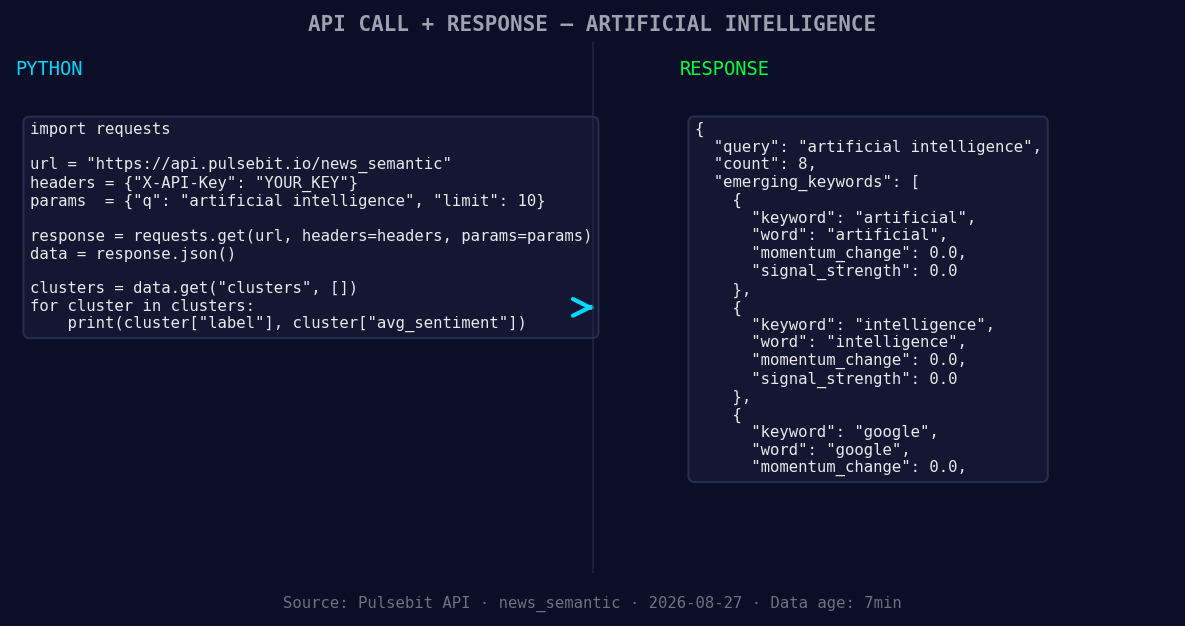
*Left: Python GET /news_semantic call for 'artificial intelligence'. Right: returned JSON response structure (clusters: 3). Source: Pulsebit /news_semantic.*
# Geographic origin filter: Spanish language
response = requests.get('https://pulsebit.api/endpoint', params={
'topic': topic,
'lang': 'sp', # Spanish language filter
'score': score,
'confidence': confidence,
'momentum': momentum
})
data = response.json()
print(data)
Next, we can run the cluster story back through our sentiment analysis to gauge the narrative framing. This is essential for understanding how the articles cluster around shared themes. Let’s score this specific narrative:
# Meta-sentiment moment: analyzing the cluster reason string
cluster_reason = "Clustered by shared themes: intelligence, college, artificial, applications, ktv"
sentiment_response = requests.post('https://pulsebit.api/sentiment', json={
    'text': cluster_reason
})

meta_sentiment = sentiment_response.json()
print(meta_sentiment)
This analysis brings to light the forming themes: artificial (+0.00), intelligence (+0.00), and google (+0.00), contrasting with mainstream discussions around intelligence, college, and artificial. Recognizing these shifts can help you stay ahead of the curve.
Now let’s explore three specific builds you can implement based on this anomaly:
Geo-Filtered Alert System: Create an alert for any articles with a sentiment score below -0.700 from Spanish sources. This will help you react quickly to negative sentiment shifts in regions where English is not the primary language.
Meta-Sentiment Report Generator: Build a function that automatically scores narrative frames like "Clustered by shared themes" and flags any significant deviations from historical norms. Set a threshold for alerts at a confidence level of 0.85 or higher.
Trend Analysis Dashboard: Develop a dashboard that visualizes sentiment over time, specifically focusing on the forming themes around artificial intelligence. Use a signal strength threshold of 0.809 to filter out noise and present only the most relevant data.
By integrating these builds, you can ensure your pipeline is not only catching up but staying ahead of the latest trends in AI sentiment.
If you're ready to get started, check out our documentation and see how you can implement these insights in under 10 minutes.