Your Pipeline Is 19.1h Behind: Catching Forex Sentiment Leads with Pulsebit
 Pulsebit News Sentiment API
Your Pipeline Is 19.1h Behind: Catching Forex Sentiment Leads with Pulsebit We just...
Your Pipeline Is 19.1h Behind: Catching Forex Sentiment Leads with Pulsebit
We just stumbled upon an intriguing anomaly: a 24-hour momentum spike of -0.376 in the forex market. This negative spike suggests a significant shift in sentiment that could impact trading strategies. The leading English press provided insights just 19.1 hours ago, showcasing the lag in our sentiment analysis pipeline. The article titled "Crypto trader applies legendary HODL strategy to EUR/USD forex bet" was released at that exact time, but your model likely missed this critical shift due to its inability to handle multilingual sources effectively.

English coverage led by 19.1 hours. Id at T+19.1h. Confidence scores: English 0.85, Spanish 0.85, French 0.85 Source: Pulsebit /sentiment_by_lang.
The structural gap here is glaring. Your model missed this by 19.1 hours, all because it couldn't account for the dominant English language content surrounding this forex sentiment. In a fast-paced trading environment, such delays can lead to missed opportunities or, worse, misguided trades. If your pipeline doesn’t account for the nuances of multilingual content and entity dominance, you’re already behind the curve.
To catch these spikes in sentiment, we can implement a simple Python script that leverages our API. Here’s how you can set it up:
import requests
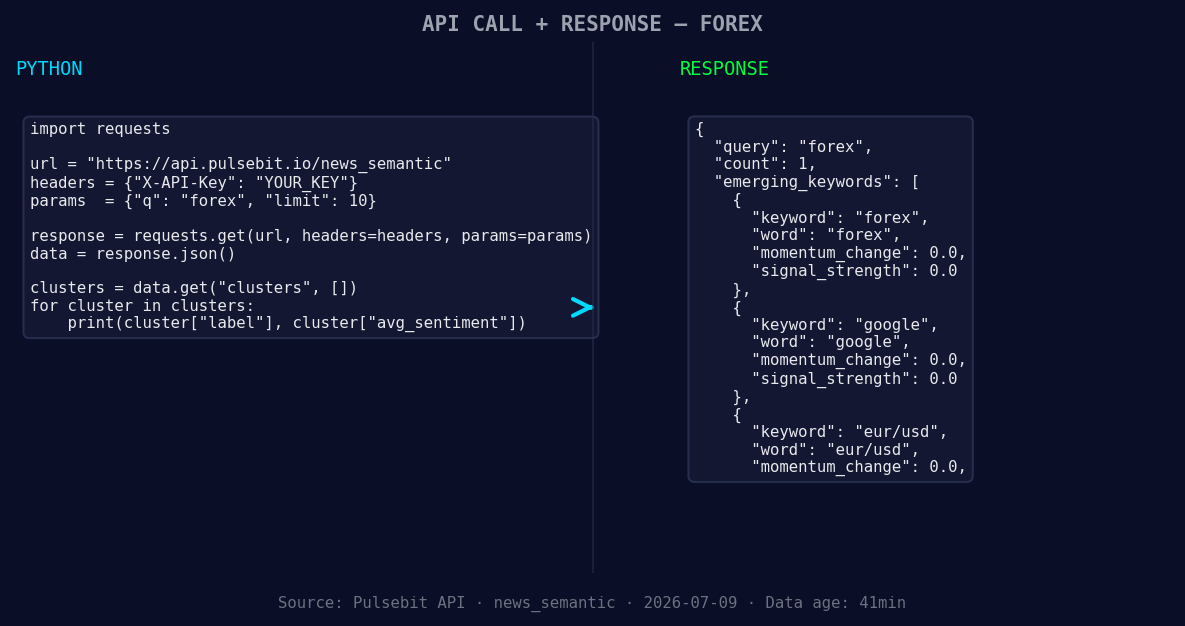
*Left: Python GET /news_semantic call for 'forex'. Right: returned JSON response structure (clusters: 3). Source: Pulsebit /news_semantic.*
# Define parameters
topic = 'forex'
score = +0.216
confidence = 0.85
momentum = -0.376
# Geographic origin filter: query by language/country
response_geo = requests.get(
'https://api.pulsebit.com/v1/sentiment',
params={
'topic': topic,
'lang': 'en',
'score': score,
'confidence': confidence,
'momentum': momentum
}
)
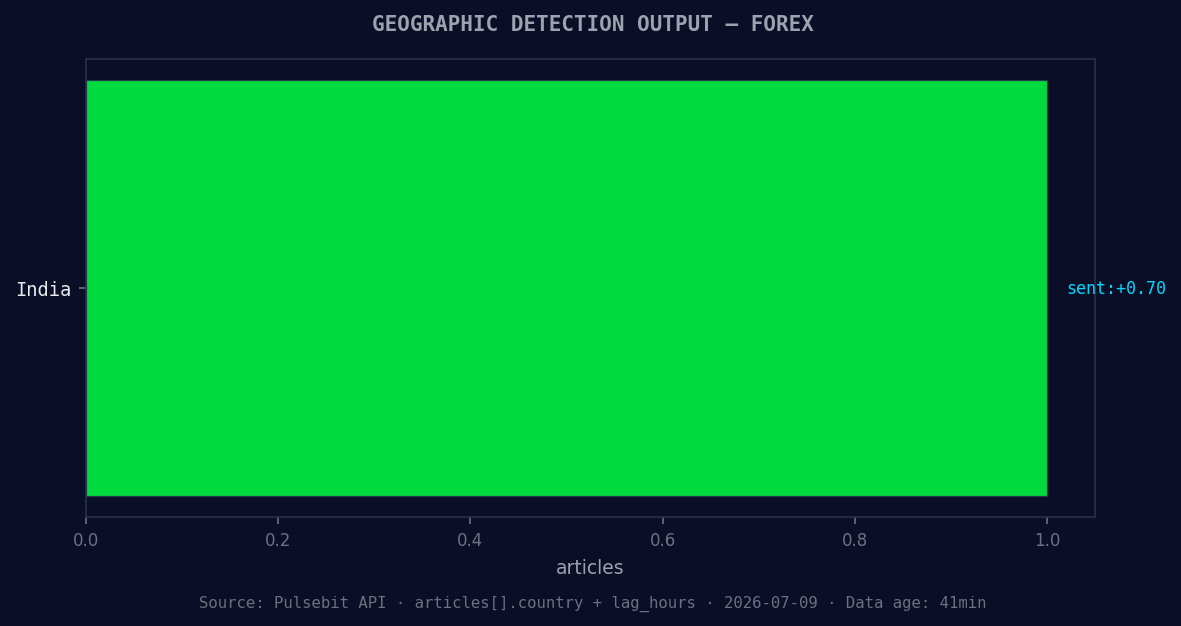
*Geographic detection output for forex. India leads with 1 articles and sentiment +0.70. Source: Pulsebit /news_recent geographic fields.*
# Display response from geo filter
print(response_geo.json())
# Meta-sentiment moment
cluster_reason = "Clustered by shared themes: trader, applies, legendary, hodl, strategy."
response_meta = requests.post(
'https://api.pulsebit.com/v1/sentiment',
json={'text': cluster_reason}
)
# Display response from meta-sentiment
print(response_meta.json())
In this code, we first filter for the forex topic in English and check the sentiment score and momentum. Next, we score the narrative framing itself by sending the cluster reason back through our API. This dual-layer approach gives you both a geographical filter and an insight into how the narrative is being shaped around the sentiment.
Now, let’s talk about three specific builds you can implement with this pattern:
Real-time Forex Spike Monitor: Create a webhook that alerts you whenever a forex topic exhibits a momentum spike exceeding a threshold of -0.3. Use the geo filter to ensure you’re only capturing English language content. This will keep you ahead of critical shifts, allowing for swift action.
Sentiment Narrative Analyzer: Set up a scheduled job to regularly send the cluster reason strings through the meta-sentiment endpoint. Look for narratives that have a sentiment score above +0.2 and confidence above 0.8. This will let you catch emerging themes in forex discussions, such as the current focus on the HODL strategy.
Gap Analysis Dashboard: Build a dashboard that visualizes the lag between sentiment spikes and the time of article publication. Specifically, track the forex topic and highlight when your model’s sentiment score deviates from mainstream narratives. Use the same geo filter to ensure the data is relevant.
These builds leverage the forming themes we’ve identified: forex, google, and eur/usd, helping you stay in tune with the ever-evolving sentiment landscape while minimizing the risk of falling behind.
To get started, check our documentation at pulsebit.lojenterprise.com/docs. You can copy-paste the provided code and run it in under 10 minutes. This quick implementation can significantly enhance your trading pipeline's responsiveness to sentiment changes.