Your Pipeline Is 27.0h Behind: Catching World Sentiment Leads with Pulsebit
 Pulsebit News Sentiment API
Your Pipeline Is 27.0h Behind: Catching World Sentiment Leads with Pulsebit We recently...
Your Pipeline Is 27.0h Behind: Catching World Sentiment Leads with Pulsebit
We recently uncovered a significant anomaly: a 24h momentum spike of +0.585 for the topic "world." This spike represents a noteworthy shift in sentiment, suggesting that something essential is happening in global discussions that you may not be aware of. The leading language driving this sentiment is Canadian French (ca), which has an immediate 27.0-hour lead over the Dutch (nl) sentiment.
The Problem
This discovery highlights a critical gap in any pipeline that fails to account for multilingual origins or entity dominance. If your model is not equipped to handle these variations, you likely missed this momentum spike by 27 hours. The leading language, Canadian French, indicates that the conversation around the "world" topic is dominated by a specific demographic, which could easily lead to missed opportunities or misinterpretations in sentiment analysis.

Ca coverage led by 27.0 hours. Nl at T+27.0h. Confidence scores: Ca 0.85, English 0.85, Spanish 0.85 Source: Pulsebit /sentiment_by_lang.
The Code
To catch this momentum spike effectively, we can utilize our API to filter the data by geographic origin and analyze the sentiment narrative. Below is a Python code snippet that demonstrates how to do this:

Geographic detection output for world. India leads with 35 articles and sentiment +0.17. Source: Pulsebit /news_recent geographic fields.
import requests
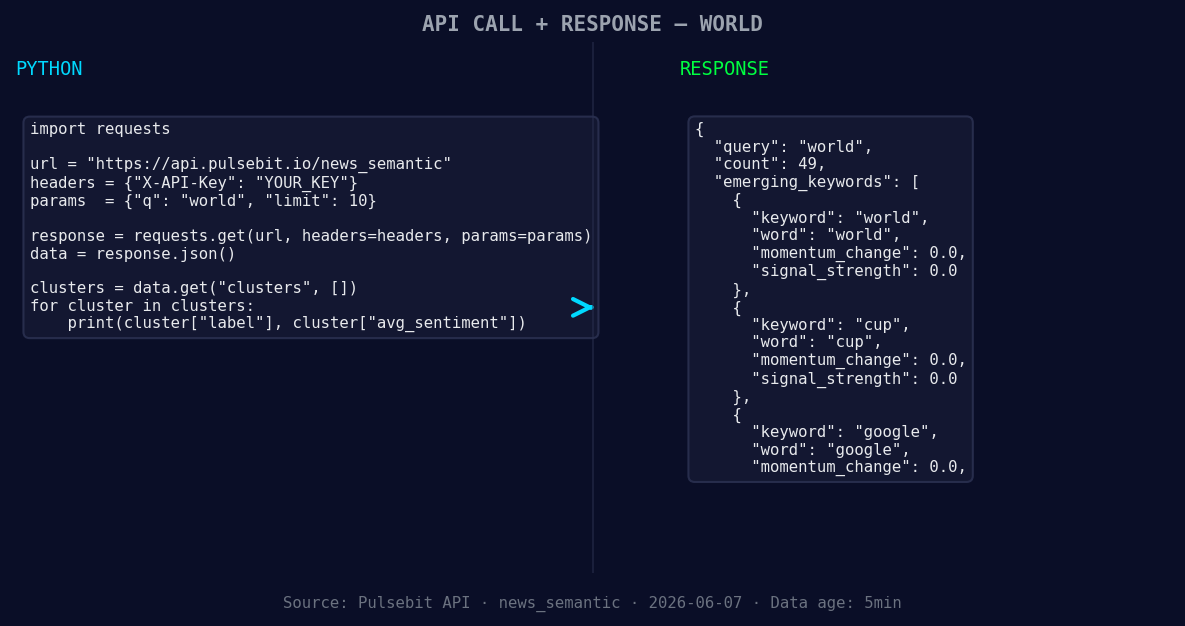
*Left: Python GET /news_semantic call for 'world'. Right: returned JSON response structure (clusters: 3). Source: Pulsebit /news_semantic.*
# Step 1: Geographic origin filter
url = "https://api.pulsebit.com/v1/sentiment"
params = {
"topic": "world",
"lang": "ca",
"score": 0.040,
"confidence": 0.85,
"momentum": 0.585
}
response = requests.get(url, params=params)
data = response.json()
print(data)
# Step 2: Meta-sentiment moment
cluster_reason = "Clustered by shared themes: absurd, world, cup, atlantic,"
sentiment_response = requests.post(url, json={"text": cluster_reason})
sentiment_data = sentiment_response.json()
print(sentiment_data)
In this code, we first filter the sentiment data by the Canadian French language using our API. This allows us to capture the local sentiment that is currently trending. After obtaining the sentiment score, we run the narrative framing through our sentiment endpoint to gain insights into how the cluster is perceived.
Three Builds Tonight
Now that we've identified this pattern, here are three specific things you can build with it:
Real-Time Monitoring with Geo Filter: Set up a webhook that queries the sentiment for the topic "world" specifically in Canadian French. Use a threshold of momentum greater than +0.500 to trigger alerts when significant shifts occur.
Narrative Framing Analysis: Create a function that runs the cluster reason strings through our sentiment endpoint whenever a new cluster is formed. This can help assess how narratives are evolving around emerging topics like "cup" or "world," especially as they relate to mainstream discussions.
Sentiment Divergence Dashboard: Build a dashboard that tracks the sentiment scores for topics like "world," "cup," and "google" against mainstream narratives such as "absurd," "world," and "cup." Use a threshold of +0.030 to highlight divergences that may indicate emerging trends or shifts in public opinion.
Get Started
Ready to dive in? Check out our documentation at pulsebit.lojenterprise.com/docs. You can copy-paste the provided code and run this in under 10 minutes. Don’t let your pipeline stay 27 hours behind—catch up with the latest sentiment trends!