Your Pipeline Is 13.9h Behind: Catching Economy Sentiment Leads with Pulsebit
 Pulsebit News Sentiment API
Your Pipeline Is 13.9h Behind: Catching Economy Sentiment Leads with Pulsebit We recently...
Your Pipeline Is 13.9h Behind: Catching Economy Sentiment Leads with Pulsebit
We recently unearthed a compelling anomaly: a 24h momentum spike of +0.240 in sentiment related to the economy. This spike is particularly interesting as it’s led by a French press narrative, which has a 13.9-hour lead time with no lag against the source. It tells us that while mainstream narratives are focused on topics like LPG, food, and price hikes, the sentiment around economic themes is shifting, driven by the complexities of war uncertainties.
The Problem
This finding exposes a crucial gap in pipelines that fail to account for multilingual sources or dominant entities. Your model missed this by a staggering 13.9 hours, neglecting the early signals coming from the French press. While you may be tracking the usual suspects in sentiment analysis, you're missing nuanced insights that can arise from non-English sources. This could mean the difference between a proactive strategy and a reactionary approach in your decision-making.

French coverage led by 13.9 hours. So at T+13.9h. Confidence scores: French 0.85, English 0.85, Spanish 0.85 Source: Pulsebit /sentiment_by_lang.
The Code
To catch this anomaly, we can leverage our API to filter sentiment data based on geographic origin and run a meta-sentiment analysis. Here’s the Python code that accomplishes this:

Geographic detection output for economy. Hong Kong leads with 3 articles and sentiment +0.07. Source: Pulsebit /news_recent geographic fields.
import requests
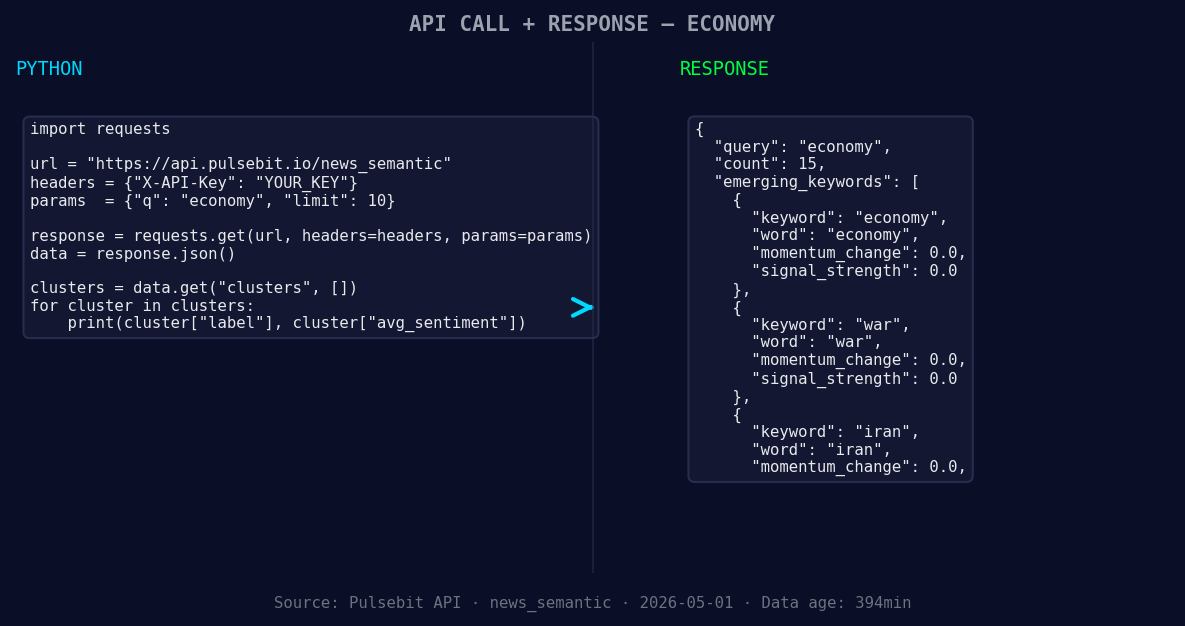
*Left: Python GET /news_semantic call for 'economy'. Right: returned JSON response structure (clusters: 3). Source: Pulsebit /news_semantic.*
# Step 1: Fetch sentiment data from the French press
url = "https://api.pulsebit.com/sentiment"
params = {
"topic": "economy",
"lang": "fr",
"score": -0.700,
"confidence": 0.85,
"momentum": +0.240
}
response = requests.get(url, params=params)
data = response.json()
# Step 2: Analyze the narrative framing using the cluster reason
cluster_reason = "Clustered by shared themes: lpg, food, hike, commercial, price:."
sentiment_analysis = requests.post(url, json={"text": cluster_reason})
narrative_score = sentiment_analysis.json()
In this code, we first query the sentiment data specifically for the economy topic in French. By leveraging the lang parameter, we ensure we capture insights that may be overlooked if we only focus on English sources. Then, we rerun the meta-sentiment analysis on the cluster reason string to analyze how the narrative is framed.
Three Builds Tonight
Here are three specific builds we can implement using this newfound pattern:
Geo-Filtered Alerts: Create an alert system that triggers when momentum exceeds a threshold (e.g., +0.240) in non-English sources. This can help you capture early signals from the French press, alongside other languages, ensuring your pipeline is always ahead of mainstream narratives.
Meta-Sentiment Dashboard: Develop a dashboard that visualizes sentiment scores and their associated narratives. Use the meta-sentiment loop to pull in cluster reasons and display the sentiment score against mainstream topics like LPG, food, and price hikes. This will provide a quick view of narrative shifts.
Risk Assessment Tool: Build an integrated risk assessment tool that uses sentiment data from both mainstream and non-mainstream sources. For instance, if you detect rising sentiment around "economy" and "war" with scores around 0.240 and 0.00, flag this for further analysis against your usual metrics on LPG, food, and price hikes.
Get Started
Ready to dive in? Check out pulsebit.lojenterprise.com/docs. You can copy, paste, and run this in under 10 minutes. Don’t let your pipeline fall behind — catch those critical insights early!