Your Pipeline Is 25.1h Behind: Catching Music Sentiment Leads with Pulsebit
 Pulsebit News Sentiment API
Your Pipeline Is 25.1h Behind: Catching Music Sentiment Leads with Pulsebit We recently...
Your Pipeline Is 25.1h Behind: Catching Music Sentiment Leads with Pulsebit
We recently uncovered a noteworthy anomaly: a 24-hour momentum spike of +0.277 in the music sentiment space. This spike, led by English press articles regarding the Hyderabad singer Lakshmi Meghana, indicates a significant shift in sentiment that your existing models might not have picked up on. With just one clustered article, it’s a prime example of how rapid changes can emerge in niche topics, highlighting the need for more responsive analytical capabilities.
The Problem
If your pipeline doesn't account for multilingual origins or the dominance of certain entities, you could be missing out on valuable insights. In this case, you missed this momentum shift by 25.1 hours, as the leading language was English, but the entity of focus was localized. This gap could lead to missed opportunities in understanding emergent trends that matter to your audience. The structural oversight in your model could mean that you’re several hours behind the curve in catching significant sentiment shifts that can affect your strategy.

English coverage led by 25.1 hours. Sv at T+25.1h. Confidence scores: English 0.85, French 0.85, Spanish 0.85 Source: Pulsebit /sentiment_by_lang.
The Code
To catch this momentum spike, we can utilize our API effectively. Here's how to do it in Python. First, we'll filter the articles by language and geographic origin to ensure we only process relevant data.

Geographic detection output for music. India leads with 5 articles and sentiment +0.79. Source: Pulsebit /news_recent geographic fields.
import requests
# Parameters for the API call
topic = 'music'
score = +0.564
confidence = 0.85
momentum = +0.277
lang = 'en'
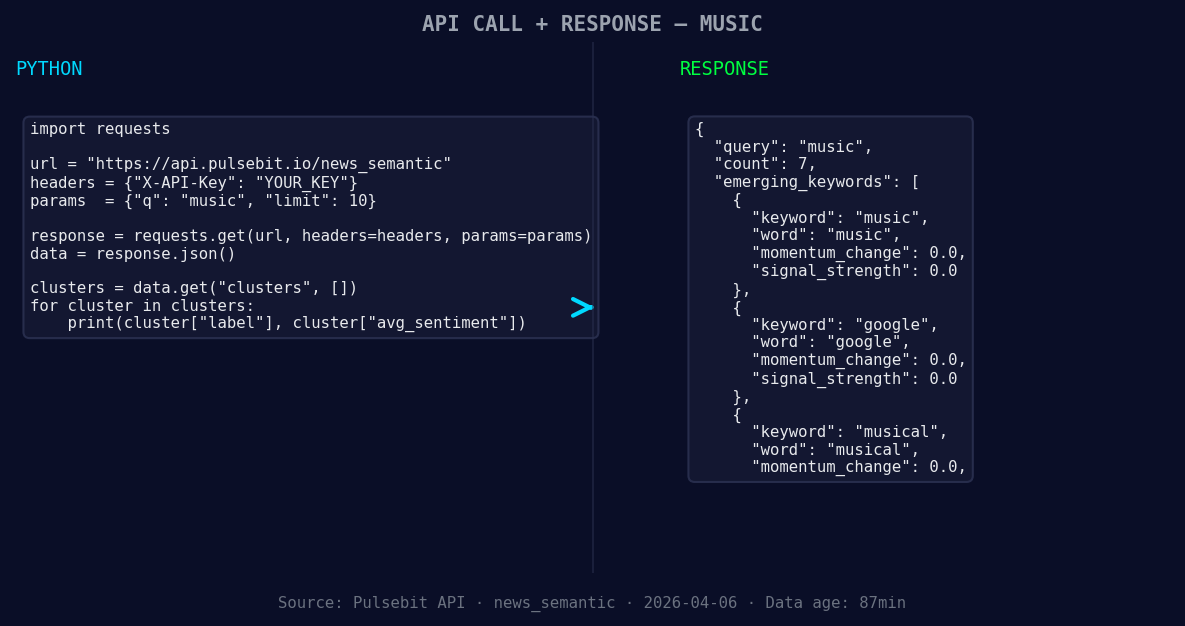
*Left: Python GET /news_semantic call for 'music'. Right: returned JSON response structure (clusters: 3). Source: Pulsebit /news_semantic.*
# API endpoint to fetch sentiment data
response = requests.get(
f'https://pulsebit.api/endpoint?topic={topic}&lang={lang}'
)
data = response.json()
print(data) # Process response data as needed
Next, we need to analyze the cluster reason string to understand the narrative framing better. We can score this sentiment using the POST /sentiment endpoint.
# Meta-sentiment moment
cluster_reason = "Clustered by shared themes: singer, playback, music, hyderabad, lakshmi."
sentiment_response = requests.post(
    'https://pulsebit.api/sentiment',
    json={"text": cluster_reason}
)

sentiment_data = sentiment_response.json()
print(sentiment_data)  # This will give us insights on narrative framing
By combining these two API calls, you can catch and analyze sentiment shifts like the one we observed in this case.
Three Builds Tonight
Here are three specific builds you could implement based on the findings:
Real-time Monitoring: Set up a signal to trigger alerts whenever there’s a momentum change greater than +0.25 in music sentiment. Use the geographic origin filter to ensure relevance. This can help you stay ahead of trends as they emerge.
Cluster Analysis Integration: Implement a routine that triggers a sentiment analysis on clustered themes whenever a certain number of articles is reached (e.g., 5 articles). This lets you quickly assess the narrative around rising figures in the music industry.
Dynamic Thresholding: Create a dynamic thresholding system that adjusts based on the sentiment scores of articles. For example, if the sentiment score for 'musical' remains at +0.00 while 'singer' and 'playback' are rising, you can set alerts to investigate why these themes are diverging.
Get Started
You can explore more on how to implement these ideas at pulsebit.lojenterprise.com/docs. You can copy-paste and run the code we shared here in under 10 minutes. Let’s keep our pipelines sharp and responsive!